
Record through your own outer ears.
Binaural recording is a core EarEqual BCR function. Its microphones sit at the blocked ear-canal entrances and face outward, so your own head, pinnae and conchae shape the sound before it reaches the microphones.
Keep the anatomy that creates the cues.
Because the microphone body sits at the ear entrance rather than occupying much of the concha, the listener's own outer-ear geometry remains substantially unobstructed. The downstream ear-canal transfer is excluded from the recording, while the individual head, pinna and concha cues remain in the captured left and right signals.
Record both ears as true left and right channels.
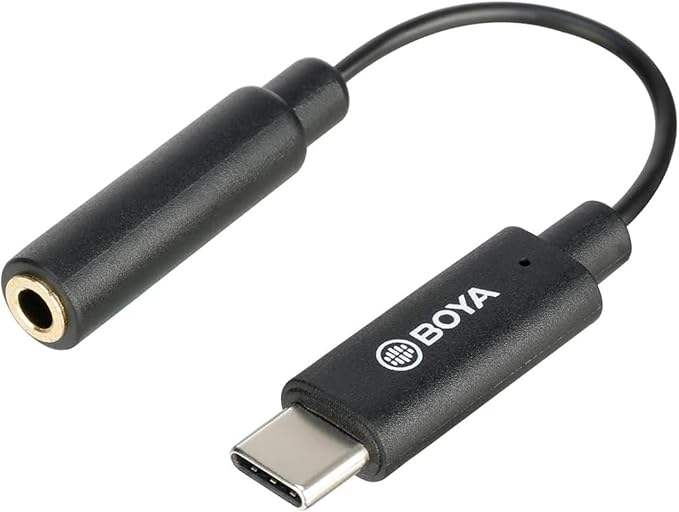
BOYA BY-K4
The BOYA BY-K4 accepts BCR's stereo 3.5 mm TRS microphone signal and can keep the left and right microphones as separate USB audio channels where host compatibility permits.
On compatible hosts, that gives BCR a simple, low-cost path to binaural recording on a USB-C smartphone, tablet or computer.
Do not substitute a normal USB-C headset dongle. Those usually provide only a mono microphone input even though they can look almost identical.
For standalone recording, a portable recorder such as the Tascam DR-05XP is another full-stereo option. See the setup guide for the current connection hierarchy.
Record and calibrate at the same acoustic reference point.
The same BCR can later measure the headphones at essentially the same blocked-ear reference plane used for the recording. For playback of your own binaural recording, capture and headphone measurement are therefore directly comparable at the same acoustic plane.
The recording itself provides the playback reference.
Conceptually, the headphone calibration becomes the inverse of the measured headphone transfer function at BCR reference plane. When you remove BCR and listen normally, your own real ear canals are physically back in the reproduction path.
A clean reference architecture, not a claim of mathematical perfection.
The headphone is measured while the entrance is blocked by BCR and listened to with BCR removed. If a headphone changes response significantly with acoustic load, the blocked measurement can differ from normal listening. This is especially relevant for some pressure-sensitive closed-back headphones.
The important advantage is that the separate target-definition problem disappears for your own binaural recordings. The remaining caveat is headphone loading, not uncertainty about where the recording and headphone measurement are referenced.